People of the Ten Years' War, 1868-1878
Three separate lists of Cubans caught up in the Ten Years' War, brought together here as one searchable collection: the officers of the Republic in Arms, the people Spain deported or imprisoned, and the people whose property Spain confiscated or embargoed. 5,086 records for 4,806 people, and where the same name runs through more than one list, the records are held together, so a captain who also lost his estate is one person carrying both.
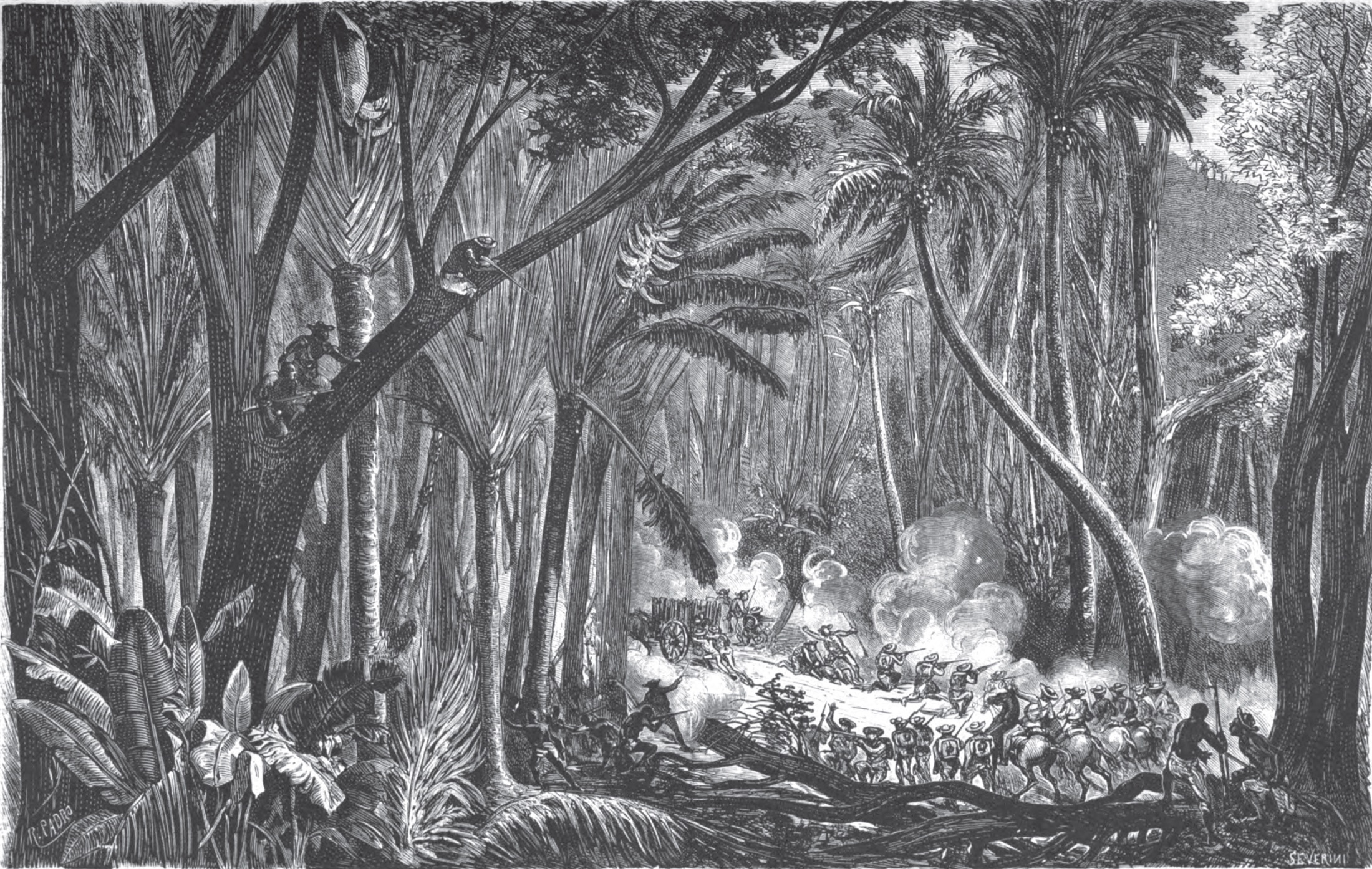
"Un combate en la manigua," Isla de Cuba, published in La Ilustración Española y Americana*, 16 March 1872.*
The war
On 10 October 1868, at his estate La Demajagua near Manzanillo, the planter Carlos Manuel de Céspedes freed the people he held enslaved, invited them to join him, and declared war on Spain. That morning, the Grito de Yara, began ten years of fighting across the eastern half of the island. The rebels took Bayamo within days, and by April 1869 the assembly at Guáimaro had written a constitution and named a republic. Its army, the mambises, fought a mounted guerrilla war against a far larger and better-supplied Spanish force.
Spain answered in the towns as much as in the field. Suspected sympathisers were tried by military tribunal and shipped to the penal colonies at Ceuta and Fernando Poo; estates and businesses belonging to families with a son in the manigua were embargoed or confiscated outright; eight medical students were shot in Havana in November 1871, and fifty-three men taken from the steamer Virginius in November 1873. Something near 190,000 people died over the decade, most of them of disease.
The war ended in exhaustion rather than victory. The Pact of Zanjón was signed on 10 February 1878; it promised reforms and delivered few, and Antonio Maceo refused it at Baraguá five weeks later before the last holdouts gave in that May. Slavery was abolished by stages, ending in 1886. The men and women in this collection are the same generation who went back to war in 1895, a fact worth holding onto when a name here also turns up in the Mambí fighters of 1895-1898.
Officers of the Republic in Arms: 2,438 records. Officers, deputies and officials of the republic, compiled by CubaGenWeb from published and unpublished works and made available to researchers. Each entry can carry rank or position, the date of the rank and of entry into service, birthplace, military zone, death date, the parents' first names, and the compiler's reference. Most of the surviving Ten Years' War paperwork left Cuba for the Spanish military archive at Segovia when colonial rule ended, so these entries are largely reconstructed from what was printed instead: the Boletín del Archivo Nacional de Cuba; the campaign diaries of General Vicente García and of Máximo Gómez; Emilio Bacardí Moreau's Crónicas de Santiago de Cuba; Vidal Morales y Morales' Hombres del 68; Octaviano Portuondo Moret's Presencia de Santiago de Cuba en la Guerra del 68; Carlos Roloff's Índice alfabético y defunciones del Ejército Libertador; and an unpublished manuscript by Col. Benjamín Ramírez.
Deported and imprisoned: 610 records. Cubans sentenced to deportation or hard labour, from CubaGenWeb, drawn largely from the work of Humberto Estrada del Sol and from The Book of Blood (1873), the contemporary record of Spanish policy in the war. Entries give the date of deportation, the ship, the prison (Ceuta, Fernando Poo, the presidios of the peninsula), the sentence, and often the death that followed it.
Sanctioned by the Spanish authorities: 2,038 records. Confiscations, embargoes and forced emigrations imposed in the first years of the war, transcribed by the Cuban Genealogy Club of Miami from the emigre newspaper La Revolución, which printed the Spanish notices as they appeared through 1869 and 1870. Each entry gives the name as listed, the jurisdiction, the sanction, and the issue it was published in.
Reading the records
Every record keeps the original row exactly as it was transcribed, alongside the standardised fields the search uses. Names in all three lists were recorded without accents and are searched that way; a name may be spelled two or three ways across the lists, so try a surname on its own before a full name.
Dates are given as they were found. Where the source wrote something other than a date in a date column ("died on the ship or in the hospital after landing", "18xx") the record keeps the sentence and is flagged for review rather than being forced into a year. Three of the compilers' source abbreviations (MCMR, NCBR, VVN) have never been resolved to a work, and the records citing them say so.
Ranks, zones and places are the source's own Spanish. A person here is a person named in a list, not a verified identity: entries with the same name may be one man or two, and the collection is a starting point for research rather than proof of it.
Search the archive · All collections · Sitemap